World's 2nd ceramic stamp- this time from Netherlands-
released on 07-09-2026
About Delft Blue Ceramic Stamp
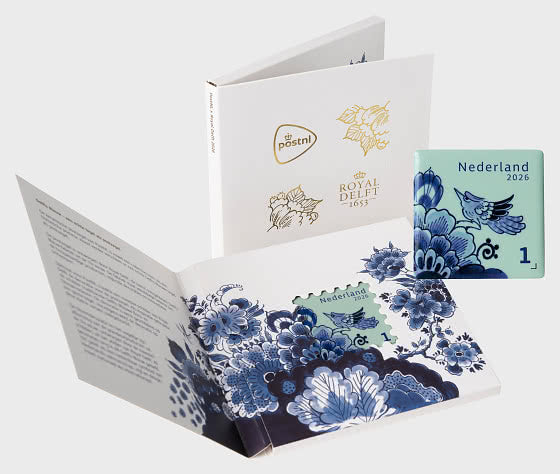
With this innovation, PostNL is breaking entirely new ground in the field of philately, adding a unique collector’s item to the already rich history of Dutch postage stamps. The Delft Blue Ceramic Stamp is therefore both a historic novelty and a collector’s item. It is also the first time that PostNL and the producer, Royal Delft, have brought a ceramic stamp to market.
Background
In the 17th century, Chinese blue-and-white porcelain was enormously popular in the Republic of the Seven United Netherlands, as the Netherlands was known at the time. The prosperity of the Dutch Golden Age created a substantial market for luxury household objects such as Chinese porcelain. The Dutch East India Company (VOC) therefore transported vast quantities of this porcelain to the Republic. Porcelain from the Chinese Ming dynasty (1368-1644) was particularly popular among wealthy citizens. Around the middle of the century, however, problems arose with its supply. Following the fall of the Ming dynasty, civil wars and political turmoil broke out in China. As a result, the production and export of porcelain came to a halt. Less Chinese porcelain was available, while demand remained high.
The emergence of Delft Blue
Potters in Delft recognised a commercial opportunity. Although they were unable to produce genuine porcelain, they succeeded in creating something that closely resembled it: refined tin-glazed earthenware decorated with blue cobalt oxide paintings. Naturally, they drew inspiration from examples from China, as that was what the market demanded. They therefore used many Chinese motifs and subjects, such as landscapes and floral scrolls. When Chinese and Japanese porcelain later became widely available again, Delft Blue remained popular. By then, it had developed its own distinctive style and identity, featuring typically Dutch subjects such as ships and seascapes, windmills and Biblical scenes.
Royal Delft, established in 1653
During its heyday, Delft was home to dozens of pottery factories. One of the last remaining producers of Delft Blue pottery is Royal Delft, founded as De Porceleyne Fles in 1653. Ceramic masterpieces are still produced here with exceptional craftsmanship and precision. The Delft Blue Ceramic Stamp is a fine example of this.
DESIGN
The Delft Blue Ceramic Stamp is more than just a means of postage: it is a real, thin tile in stamp format! Quite extraordinary, as a genuine Delft Blue tile has never before appeared as a postage stamp, despite Delft Blue having existed for more than three centuries. Joffrey Walonker, Design Manager at Royal Delft, is enthusiastic about this unique collaboration with PostNL:
“The challenge was to tell the story of Royal Delft within such a limited space. Royal Delft is renowned for its grandeur pieces, such as those produced in the 17th century. It was a time when people mainly invested in property, art, clothing and Delft Blue. We still create these products at the very highest end of the market. The decoration used was specially designed for the Delft Blue Ceramic Stamp and features a floral bouquet with a bird. This theme has been used on our pottery since the 17th century, particularly on products in our premium range.”
Grandeur
These grandeur pieces are iconic works of pottery that demonstrated not only the wealth of their owners but also their taste. They were produced during the Dutch Golden Age, mainly in Delft. They were rarely everyday household items but rather showpieces for wealthy merchants’ homes, palaces and collectors. They were often displayed on lavishly laid dining tables, making them highly visible to guests and a natural topic of conversation.
Traditional motifs
Joffrey Walonker: “To tell the story of Royal Delft properly, we really needed more space than a postage stamp allows. The starting point was therefore a tile featuring a life-size decoration painted by one of our master painters. The stamp is effectively a fragment of this larger decoration, which continues onto the packaging. We then digitised this fragment, printed it on the ceramic stamp tile and applied a coating to give it a glossy finish, making the whole piece look like a genuine tile.”
Ghost Rock
The decoration features a dark blue background originally derived from Asia. Joffrey Walonker: “This dark background is known as Ghost Rock: stone with holes inhabited by the spirits of ancestors. The bird depicted is also characteristically Delft Blue. What is amusing is that the bird has an almost cartoon-like appearance. That was done in exactly the same way in the 17th century. In the Rijksmuseum, you can see centuries-old vases with similar birds that have a somewhat comic-book style appearance. There is a certain playfulness to it as well.”
Typography
The typography for the Delft Blue Ceramic Stamp uses Royal Delft’s corporate typeface. According to Joffrey Walonker, a restrained sans serif font was deliberately chosen.
“We did not want the typeface to draw too much attention. It was not intended to stand out. It is present, but not present, if you like.”
About the designer
The Delft Blue Ceramic Stamp was designed by the design team of Royal Delft, the last remaining Delft Blue factory dating back to the 17th century. Joffrey Walonker: “It was a team effort, with the decoration created by one of our master painters.”
Royal Delft enjoys a worldwide reputation as a producer of Delft Blue pottery. Since 1653, ceramic masterpieces have been hand-painted here with exceptional craftsmanship and precision. The iconic blue-and-white pottery represents a unique combination of Dutch history, art and traditional craftsmanship.
The Delft Blue Ceramic Stamp brings tradition and innovation together beautifully. This is also reflected in the distinctive collaborations Royal Delft undertakes with contemporary designers. Examples include Henk Schiffmacher in the Royal Blue Tattoo series and Marcel Wanders in the Moooi x Royal Delft Collection.



 1995 Stamps
 Himalayan Peaks
 Gandhi

